
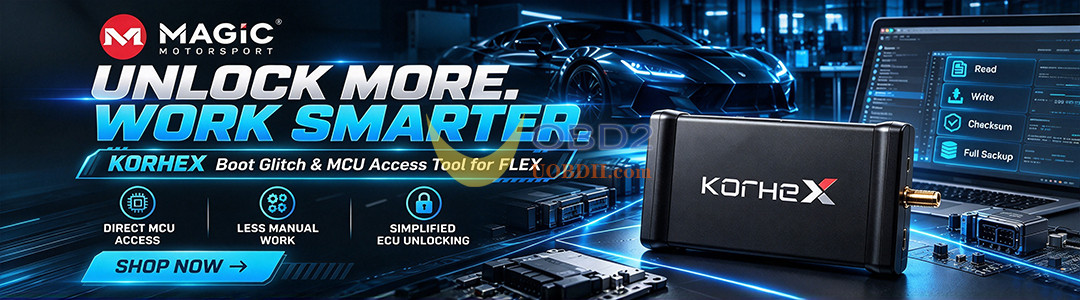


The latest Flex V8.12.0.0 software update introduces an important new capability for BMW and MINI vehicles equipped with Bosch MDG1 engine control units.
For selected last-generation MDG1 ECUs, Flex now provides a Bench protocol via pinout, eliminating the need for the traditional Boot Glitch procedure. This means tuners can access and program the ECU without opening the unit to perform the unlock.
The result is a simpler, faster, and less invasive workflow.

A Simpler Way to Work With BMW & MINI MDG1
Working with certain MDG1 control units has traditionally required additional steps, including opening the ECU and performing a Boot Glitch unlock.
With Flex V8.12.0.0, supported ECUs can now be handled directly on the bench through the appropriate pinout connection.
This means:
- No ECU opening
- No Boot Glitch procedure
- Fewer steps
- Reduced handling risk
- Faster programming workflow
For professional workshops and calibration specialists, this can make a significant difference when working with multiple vehicles.
Supported Bosch MDG1 ECUs
The new protocol is available for the following BMW Bosch control units:
- MD1CP032 — TC299
- MD1CS001 — TC298
- MG1CS024 — TC299
- MG1CS049 — TC298
- MG1CS201 — TC298
The exact ECU identification should always be verified before starting a programming operation, as compatibility depends on the specific ECU hardware and software.
Flex V8.12.0.0 Protocol Details
The new BMW/MINI MDG1 protocol operates in Bench mode and provides access to several important memory functions.
Working Mode: Bench
Memories: Read/Write/Checksum Internal Flash, Read/Write Internal EEPROM, Full Backup
Licenses: FLS0.1M/S, FLS0.10M/S, FLS0.5M/S
Connection Time: Approximately 10 seconds
Reading Time: Approximately 2 minutes 30 seconds
Writing Time: Approximately 2 minutes
These times can vary depending on the specific ECU and working conditions.
BMW & MINI Applications
The new protocol covers a range of BMW and MINI applications, including examples such as:
- BMW 4-Series Gran Coupe (I) G26 — 2021MY, 2.0L 420d MHEV, 187 HP
- BMW M2-Series (II) G87 — 2023MY, 3.0L Twin-Turbo, 453 HP
- BMW M4-Series (II) G82 — 2021MY, 3.0L Twin-Turbo, 542 HP
- BMW X2-Series (II) U10 — 2023MY, 2.0L 20d MHEV, 161 HP
- MINI Cooper F57 — 2020MY, 1.5L, 139 HP
This is only a selection of the applications covered by the new protocol, so ECU identification should be checked against the latest Flex vehicle/protocol coverage before programming.
Less Steps. Less Risk. Less Time.
The biggest benefit of the V8.12.0.0 update is the streamlined workflow.
By moving supported MDG1 operations to a Bench pinout connection, technicians can avoid opening the ECU simply to perform the unlock. This reduces the amount of physical intervention required and can make the programming process more convenient.
For busy tuning workshops, even a few minutes saved per vehicle can add up quickly.
Additional Improvements in V8.12.0.0
The update isn’t limited to BMW and MINI MDG1 coverage. Flex V8.12.0.0 also includes:
- Fixed: OBDFull connection problems on some DQ500 hardware
- Implemented: CRC support on newer MDG1 units
These changes further improve compatibility and reliability across supported applications.
